Warning
This page refers to an old version of SFML. Click here to switch to the latest version.
Warning
This page refers to an old version of SFML. Click here to switch to the latest version.
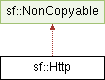
This class provides methods for manipulating the HTTP protocol (described in RFC 1945). More...
#include <SFML/Network/Http.hpp>
Classes | |
| class | Request |
| This class wraps an HTTP request, which is basically : More... | |
| class | Response |
| This class wraps an HTTP response, which is basically : More... | |
Public Member Functions | |
| Http () | |
| Default constructor. | |
| Http (const std::string &Host, unsigned short Port=0) | |
| Construct the Http instance with the target host. | |
| void | SetHost (const std::string &Host, unsigned short Port=0) |
| Set the target host. | |
| Response | SendRequest (const Request &Req, float Timeout=0.f) |
| Send a HTTP request and return the server's response. | |
This class provides methods for manipulating the HTTP protocol (described in RFC 1945).
It can connect to a website, get its files, send requests, etc.
| sf::Http::Http | ( | ) |
Default constructor.
| sf::Http::Http | ( | const std::string & | Host, |
| unsigned short | Port = 0 ) |
Construct the Http instance with the target host.
| Host | : Web server to connect to |
| Port | : Port to use for connection (0 by default – use the standard port of the protocol used) |
Send a HTTP request and return the server's response.
You must be connected to a host before sending requests. Any missing mandatory header field will be added with an appropriate value. Warning : this function waits for the server's response and may not return instantly; use a thread if you don't want to block your application.
| Req | : Request to send |
| Timeout | : Maximum time to wait, in seconds (0 by default, means no timeout) |
| void sf::Http::SetHost | ( | const std::string & | Host, |
| unsigned short | Port = 0 ) |
Set the target host.
| Host | : Web server to connect to |
| Port | : Port to use for connection (0 by default – use the standard port of the protocol used) |